Translate

Saturday, August 17, 2013

So Many Complaints, So Little Time

Instant Replay, TRs, 
Spiritual Surgeons, 
and Johnny Football


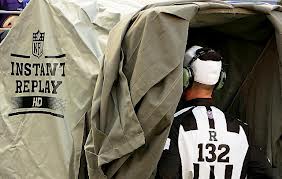
And Now to the Tape. I expect the day will come when there will be no need for umpires and referees. Every play will be automatically and instantly reviewed. The strike zone can be standardized and balls and strikes called by lasers. No close disputed double play calls. Managers will argue with unseen computers which will take all the fun out of kicking dirt, cussing, spitting, and getting sent to the showers. Already there is very little in football that actually requires an official on the field. Cameras and computers could determine the line of scrimmage on every play, and ball placement could be handled by the guys who take care of the balls on the sidelines. We can have shorter games or more commercials. Already in basketball they replay the tape to see where the toe of the shoe was when when the three point shot was released or whether on the game winning shot the ball had left the fingertips before the buzzer went off. For all sports managers and coaches may become no more necessary than they are in now the NBA. I would guess with the popularity of the fantasy leagues we could eventually get rid of players, too. It may be that only the unions,who preserve positions long after the need for them has vanished, stand between us and virtual sports. If we get rid of the human element in sports, then we can really enjoy the games. 


Rodney Dangerfields. When I was a young TR, there was no little concern about the TRs who were among RTS’ early graduates. I remember several of us being asked to meet in Jackson with the seminary President and a member of the Board of Trustees. You might say they would have liked to do a product recall. That not being possible we were told we needed to cool it.  Dr. G. Aiken Taylor published his infamous Lo the TR in The Presbyterian Journal. A ruling elder who was an old friend of my ruling elder father told my father that the problem with the TRs was that they were against women. Several of us got letters from Dr. William Hill, President of the Presbyterian Evangelistic Fellowship, asking us a number of questions mainly about evangelism. The memorable question for me was the one about whether we gave the invitation in our services. One of the negative assessments came from a somewhat surprising source, a RTS faculty member who remained in the PCUS, Mr. Otis Guy Oliver. Alumni near enough to drive to Jackson were invited back to campus from time to time for a program of some kind. One was a lecture by Mr. Oliver. All my experiences of Mr. Oliver during my student days had been positive. I remember still his polity lectures, especially the ones on the ruling elder, the deacon, and the tithe. As a part of a reading course on the Holy Spirit, he assigned me to read Frederick Dale Bruner’s still imporant book, A Theology of the Holy Spirit. So I and others were caught off guard by Mr. Oliver’s paper TR: The Anatomy of Slogan. (Sometime in recent years my copy disappeared. If anyone reading this has a copy, I would very much appreciate getting a copy of your copy.) It was, as I recall, a pretty scathing critique of us TRs. I know we did some pretty stupid things, and we may have been worse than I remember. But it seems to me that compared to today’s incarnation of TRs we were mild, perhaps even irenic. Today some of us original TRs find ourselves not liberal enough for liberals and not conservative enough for conservatives which is one of the ironies of life in the PCA. Meanwhile, Mr. Oliver got enamored of liberation theology and became known, so I hear, as Che Oliver. But, I tell ya, we just couldn’t get no respect. 


Ax or Scalpel. The last section started out as a brief introduction to this: One of the things Mr. Oliver found wrong with TRs was that they saw themselves as physicians of the soul. Lately I have been thinking about those who see themselves as soul surgeons. By their preaching, especially the application, and by their counsel, they see themselves as operating on the souls to lay open and attempt the cure of serious, potentially mortal, spiritual diseases. I am not so sure anymore about ministers viewing themselves as doctors of the soul, unless they can be guided by the prinicple "first do no harm." Sometimes I wonder whether who see themselves as surgeons use axes rather than scalpels. When you use a scalpel the point is to shed as little blood as possible and do no more cutting than is absolutely required to treat the patient's condition. Wielding the axe in the spiritual operating room leaves gaping wounds and a lot of blood on the floor. The pain inflicted may be worse than the disease it seeks to cure. The longer I am a minister the more I see congregants as mostly world weary and hurting souls whose greatest need is the soothing healing balm of the gospel applied to the wounds they already have, not new wounds. 


Then There’s Johnny Football. If believers need more gospel, John Manziel could use more law.  It seems to me that Kevin Summlin would have done himself and Texas A&M, and perhaps even Johnny and his dad a favor by jerking a knot in Johnny Football’s tail a long time ago. Winning isn’t everything. I support football programs that recruit only gentleman scholars and place a premium on sportsmanship. Go Gators!


Chomp!


Monday, August 12, 2013

You Can't Know God's Will

.


Decision Making and God's Will


During my years as a campus minister two seminars I gave always drew large attendances at statewide conferences. They were on the interrelated topics of finding God’s will and choosing a marriage partner.


Issues


Concern to know God’s will and to find the right partner are healthy Christian instincts. Christians, however inconstant the strength of the desire and inconsistent the follow through, want to please God. They know by Scripture and the Spirit that they should submit themselves to God, and they know by experience that there is misery in rebellion.


However, it is just here that there is a great deal of confusion, frustration, and unhappiness. The reason is that usually the concern is how to know the will of God vocationally (that is, what God calls us to do) with regard to college, major, job, location, marriage, and similar areas of our lives. Some have heard teaching about “being in the center of God’s will” or of “finding the perfect will of God” or of “asking God for guidance.” With regard to a marriage partner it can be about finding "the special one God has chosen for you."


The question is, “How can you know the will of God?” The problem is that you cannot find a text that says, “Go to A College, major in B, take job C, live in city D, marry E.” It’s just not there.


Of course, some think it is and practice “Bible dipping.” The old evangelical joke tells of the guy who tries this method of finding God’s will for him. He prays for guidance. He closes his eyes, lets his Bible fall open, points his finger to a text on the page, opens his eyes, and reads, “Judas went out and hanged himself.” He thinks, “There must be more to what God is saying to me,” so he goes through the same procedure. When he reads the text God has lead him to this time, he finds, “What thou doest do thou quickly.” The sum of the guidance is, “Hang yourself like Judas and do it quickly.”


The other approach it to “put out a fleece” or seek a sign to know what God wants you to do. Another old joke goes that a young man who was a farmer was seeking to know whether to keep farming or enter the ministry, so he asked God to give him a sign. One day as he was plowing he looked up into the sky and saw a cloud formation that he thought formed the letters “PC.” As he continued to plow, it struck him, “That’s my sign! It means, “Preach Christ.’” But why not, “Plant crops,” or “Pick cotton”?


Distinctions


There are two distinctions that can help us navigate our way through life as we seek to sort out this business of knowing the will of God:


(1) One is the distinction between God’s will of decree and God’s will of precept.


God’s decretive will takes in absolutely everything, even sin. It is worked out in the big and little things of God’s providential dealings with us. But it is unknowable to us except in retrospect. You know it only after it happens. Knowledge of God’s will in this sense cannot guide us through life just because it is inaccessible to us. God willed for you to marry Mary, but you did not marry Mary because you knew that.


God’s preceptive will is what he has revealed in Scripture. There he gives us commands and prohibitions. What he tells us to do and what he tell us not to do is his will for us. This we can know, though never perfectly.


We know that God’s will generally is our sanctification and specifically is that we should abstain from sexual immorality (1 Thessalonians 4:3). We know it is God’s will for us to marry “in the Lord” (1 Corinthians 7:39). These and other Biblical teachings are God’s will as we court and decide on a marriage partner.


Now it could be in God’s decretive will that you engage in premarital sex or marry an unbeliever, but, if you do either, you are outside the will God (his precepts and prohibitions) for you. The only way to seek and choose a marriage partner is to stay within those and other relevant apostolic instructions.


(2) Another distinction is between revelation then and revelation now.


We believe God gave his revelation (special not general, supernatural not natural) to prophets and apostles. That revelation came to its climax with Jesus Christ in and by whom God has spoken to us in these last days (Hebrews 1:1,2). The age of revelation came to its conclusion with the death of the last apostle. The revelation was complete when the last word of Holy Scripture was written.


During the prophetic and apostolic age God sometimes gave specific, concrete revelation. Samuel knew Saul’s father’s donkeys had been found so that Saul could cease his search and remain with Samuel (1 Samuel 9:3-20). When Paul and his associates were planning to go to Bythinia, the Spirit prevented them, so they went to Troas where God revealed to Paul in a dream that they should go to Macedonia (Acts 16:7-11). However, this kind of revelation seems to have been rare even in Biblical times. Believers could not rely on a revelation to know what to do now or next.


Where do we look for revelation today? The only revelation we have now is in the Scriptures. They alone are our infallible rule of faith and practice. Such revelation as God wanted preserved for us in this age is found in the Bible. The will of God we can know and by which we can be guided is the will of God we find in the Holy Writings. These are profitable for “teaching, reproof, correction, and training in righteousness” (2 Timothy 3:16) By the Scriptures the minister as man of God is made “competent, equipped for every good work” (2 Timothy 3:17) of his calling and by his right use of them the people of God are also equipped in the good works God calls them to do. This is one of the things we mean when we speak of the sufficiency of Scripture.


Decisions


Where does this leave us? When it comes to living our lives, we are to live within the negative and positive commands of God. It’s always right to do right and always wrong to do wrong.


What then? We have to make decisions. The best decisions we can make. Then we live with them, rejoicing in the decisions that work out well, correcting the decisions that seem not to have worked out if we can, living with and making the best of the decisions we can’t fix, confident that God’s will is to be accomplished in the good and the bad ones. He will cause all things to work together for our good. He will see to it that the good work he has begun in us will be completed.


We may wish we could know the will of God about the big decisions in life in a more precise and concrete way. We so much want certainty. We so much want to avoid mistakes and the responsibility for and consequences of the bad ones. But it is not God’s will for us to give such certainty.


We live in the age of the maturity of God’s people. When children are young we give them many detailed instructions. Get up at 6. Wear the yellow shirt, blue shorts, and tennis shoes. Have Cheerios. Go outside and play. Take your nap from 2 till 3. Eat your peas. Go take your bath. Get in bed at 8. But, as they grow older, we do not want them turning to us for every decision, so we give them more and more room for making decisions for themselves. We are preparing them for adulthood, when we hope that, having absorbed the principles we have taught them, they will make responsible and wise decisions.


God has given us the Bible, that teaches us everything we need to know about his will. That’s all we need. Equipped by his Word we live our lives making decisions. We do not live in fear that God will slap our hands if take path A rather than path B. God has decreed which path you will take, but you cannot know what he has decreed, so make a decision and go down one or the other. If you don’t have much ability in math he probably has not called you to be a rocket scientist, but there are any numbers of careers and jobs you could choose.


He has told you not to marry John because he is not a believer, but he has not told you to marry Bob or Jim or Richard. As Paul instructed the church at Corinth about the widows, “But if her husband dies, she is free to be married to whomever she wishes, only in the Lord” though Paul believes she will be happier if she does not remarry at all (1 Corinthians 7:39, 40).


There is one person for you (at a time) in terms of God’s decree. Don’t try to figure it out. There is not one person for you in the romantic or relational sense. Make the best and wisest decision you can. There are any number of people with whom you could make a stable and fulfilling marriage. There is no such thing as “just one.”


One other thing. God does not promise a perfect match between you and your school, or career, or church, or spouse. He does not guarantee compatibility and harmony. What he promises is that the guidance of Scripture is all we need and that his grace will be sufficient.


Sometimes he demonstrates those realities by putting us in situations we would not choose if we had it to do over again. Sometimes our unhappiness is the context for both sanctification and joy. Sometimes we experience such great happiness that we know God’s fatherly generosity that has nothing to do with our being deserving children. God is not stingy but delights to give his children good things.


Case Study


Near the beginning and the end of Paul’s letter to the Romans he addresses his unaccomplished plans to visit Rome. (Perhaps they were wondering why he had told them he was coming but never had.) He wanted to go to impart to them some spiritual gift, to encourage and be encouraged, and to reap a spiritual harvest there as he had other places. He had often intended to visit Rome but each time he had been prevented. He did not take this as a sign that he was pushing ahead against God’s will. Rather he is making plans again and asks the Roman church join him in prayer that he might somehow by God’s will at last make that visit. (Romans 1:9-13)


The reason Paul had not made it to Rome was that opportunities kept opening for him in other places. But now it seems those have come to an end so that Paul now thinks he can plan the trip again. He plans eventually to go to Spain. He thinks he will stop by Rome on the way and stay awhile. But first he has another thing to do. He needs to go to Jerusalem and deliver to the saints there the offering that has been collected for their relief among the Gentiles. Then he will be on his way to Rome. However, he knows that there are dangers in Jerusalem. So he asks the Romans to pray that he might be delivered from unbelievers, that his service will be acceptable to the believers in Jerusalem, and that by God’s will he will come to Rome with joy and be refreshed by their fellowship. Paul is confident that when he arrives in Rome it will be in the fullness of Christ’s blessing. (Romans 15:22-32).


Did Paul get to Rome? Yes. Was it according to his plan? No. Did he ever get to Spain. We don’t know but probably not. He was delivered from danger in Jerusalem but by being taken into custody which led to detainment and trials till he appealed to have his case heard in Rome. On the way to Rome, he experienced the near loss of his life in a shipwreck. When at last he arrived in Rome he was a prisoner facing the threat of death if convicted.


Was Paul outside the will of God? Did Paul know God’s plan? Did Paul press on despite clear indications that it was not God’s will for him to go to Rome? Did Paul forfeit the blessings of Christ? No.


God is sovereign. We are not. Believe in God’s goodness. Trust his wisdom. Listen to his Word. Do his will. Live your life. Make the best of your marriage.

Did I make the right decision about a wife? Well, in the sense that I married the only woman I’ve met who wouldn’t have killed me, yes. Did she make the right decision about a husband? Who knows? She says two things about her decision: (1) She was too young to know any better. (2)I wouldn’t go away. However, if you ask her why she is still here, she will tell you it is because she promised. Good or bad decision, she’s lived with it.

Tuesday, August 6, 2013

Things That Irritate Me


Of Which I Am Foremost

Relatives of Mine


Me. I am usually irritated with me. The reason, to use the language of The Book of Common Prayer, is that I have followed too much the devices and desires of my own heart, have left undone the things I ought to have done, have done those things I ought not to have done, and there is no health in me. I pray without much problem for God to have mercy on this miserable offender, but stumble when I ask him to spare those who are penitent, usually changing it to "as thou dost make me penitent." One of the evidences that there is no health in me is that I often express my irritation with myself with irritation directed at others. Another is that right now I am pleased with myself for admitting all that. However, being irritated with myself seldom hinders me from being irritated about other things, such as...

Traffic Cameras. I have not yet been caught by one of these cameras, though I expect my day will come. It irritates me that people get notices by mail that they turned at a traffic light as it was turning red. This is a nice way for government to make money, but I doubt it has much, if anything, to do with safety. This is one of many ways we have become accustomed to the government keeping its ubiquitous eye on us.

Christian Businesses. I used frequently to go by a used car lot that on its sign prominently called attention to the fact that it was a Christian business. Just about always I thought to myself that, if I were in the market for a used car, that would be the last place I would shop. Why? Because so much of what passes for Christian business is known to cut ethical corners. Then there is treatment of people. I have seen businesses that make no claim to be Christian treat employees with dignity and compassion. On the other hand I have seen businesses operated by Christians according to "Christian principles" where the bottom line is the bottom line and where employees are treated as replaceable parts. This is not by any means universal. I remember a Christian businessman telling me of negotiations with the employees' union and saying his company was going to do a certain thing, because it was the right thing to do. I am afraid that is an exception. Then, there is the  business practice that just about all of us engage in - tipping. I am told that Christians have a reputation for being very bad tippers. I have heard announcements at General Assembly meetings that hotel staffs dread having church conventions because church people are notorious for skimping on the tips. As a father of several sons who worked as servers, this irritates me.

Kirk Cameron and His Bible. I expect that Kirk Cameron is a very sincere and nice Christian. I know he is very concerned about his country and is trying to do what he believes he should to set it right. Nevertheless, I get irritated everytime I see him on televison selling the Geneva Bible with the orginal notes included. All sorts of things, such as the fact that the Geneva Bible helped to bring about the American Revolution, are claimed. At the website there is available a "Patriot's Edition" that contains various documents, including the Magna Carta, Declaration of Independence, Constitution, and the Bill of Rights so that the reader can see how dependent these are on the Bible. I am sure all this would suprise those who produced the Geneva Bible. But the thing that most irriates me is the patently false statement that the Geneva Bible is "by the people, for the people." No doubt, if they are able, prophets and apostles turn over in their graves everytime that commercial is played. And no doubt the Author, using the divine and royal plural, says, "We are not amused."

Female Modesty. There has been quite a lot of attention given during this swimsuit season to the subject of female modesty. Much of it misses the obvious. Fallen males, some to a greater, some to lesser extent experience lust. (See the first heading of his blog.) Some fallen females are naively unaware of this reality while others are happily aware. To say that is a male problem (true) and that males just need to deal with it is both unrealistic and silly. However, as was so often the case during his lifetime, Fr. John Neuhaus wrote sane and and applicable words way back in 1994, though Rachel Held Evans is not likely to be instructed:
“The Politics of the Breast” is an opinion piece in the New York Times advocating the right of women to go bare-breasted on the subway. Two years ago the New York Court of Appeals ruled that the state laws against indecent exposure could not be enforced against women who wish to be topless in public. Judge Vito J. Titone wrote that differential treatment of female bodies violated constitutional guarantees of equality and was “rooted in centuries of prejudice and bias toward women.” One suspects he meant to say against women. A certain delicacy about the display of the female body in public is indeed rooted, apparently from the beginning of the species, in an enthusiastic male prejudice and bias toward naked women. Such considerations seem to carry little weight with the court, however. If human nature and the edicts of the court are in conflict, human nature will just have to change. Mayor Giuliani, being a generally sensible fellow, says the transit police will continue to arrest bare-breasted women on the subway. A police spokesman explains that, in the close press of subway travel, a “very, very attractive” topless woman could create excitements that would pose a public danger. Some subway patrons, he opined, could become so distracted that they might fall down escalators or even onto the tracks. The Times writer is buying none of it. She scoffs at the idea that “the power of the female breast is such that it can lure its beholders to untimely demise in subterranean channels.” She concludes that the bare-breasted subway rider is making the point “that her breasts belong to her and not to the onlookers.” It is not, however, the proprietorship but the public display of the items that is in question. To be fair to the writer, this is a man thing and it is perhaps understandable that she just doesn't get it. Her argument and that of the New York court, however, do helpfully illumine why it is so very difficult to make a case for public decency. The concepts of decency and indecency turn upon what is offensive. Today, unless you are a member of a certified victim group, you have not the right to be offended. If you are offended or, as in this case, aroused, the fault is with you. The fun for the more aggressive members of the certified victim group is to taunt and provoke you into protesting what they say or do, thus confirming that they are victims and you the victimizer. But this is old hat by now. And for all the media chatter about bare-breasted subway riders, we know nobody who has seen one to date. One expects it's not for the lack of looking. In any event, the ancient maxim is again vindicated that those whom the gods would destroy are, if madness be the sign, disproportionately New Yorkers.

Personalized Vows.  I recently read of a couple who are admirably committed to the poor. Their wedding was held under a bridge with the homeless as guests of honor. The other guests served the guests of honor by serving them food. I prefer for ecclesiatically sanctioned weddings to be held in church buildings, but then I am a fuddy-duddy. But what irritated me was that the vows had been specially written for this service and that one of the things the couple promised one another was a life of love to the "outcast." My problem is not with making care for the "outcast" an aspect of how they will live together. The problem is with the whole idea that weddings, and in particular the vows, are supposed to be personalized. Weddings, if they are to be public affairs officiated by clergy, are not the time for couples or compliant ministers to put the couple's mark on the service. They are services provided by the church, and it is for the church to impose upon couples the vows it expects them to take. If I had it all to do over again, I would, if the couple inquired about the structure of the service and the content of the vows, hand them them a copy of The Book of Common Prayer and say, "This is what we do here." No exceptions. No negotiations.  Of course, this would have resulted in even more angry brides and grooms, and brides' families getting ticked off at me. However, it would have probably enabled me even more to identify with the outcasts. (In fact I was cast out of at least two weddings, the first within months of ordination because I would not agree to the singing of We've Only Just Begun. I didn't even get a kiss for luck before I was sent on my way.) Surprising as it is to many brides (and grooms) the wedding service is not about the couple. I know many will find that irriatating to be told. 

The Freedom of Not Having a Worldview

Freedom!


Richie Havens Sings Freedom at Woodstock

I remember watching the late D. James Kennedy and the Coral Ridge worship service one Sunday morning more than 25 years ago. The Scripture he read was from Nehemiah about Nehemiah's rebuilding the walls of Jerusalem. He then proceeded to preach on the Strategic Defense Initiative. That to me was clearly a case of World and Life View run amok. Of course, the Star Wars sermon was not by any means the only thing that concerned me about Dr. Kennedy's preaching. For instance, he also preached a series on "The Gospel in the Zodiac" contending that God had placed in creation a testimony not just to his existence as Creator but to his redeeming work. This world and life view thing more and more dominated Dr. Kennedy's ministry. I once asked a PCA leader why this was the case,  and he replied, "Because he thinks America is going to hell in a handbasket, and he is trying to stop it." America may well be going to hell in a handbasket, but the so-called Christian World-and-Life View which requires Christians to think "Christianly" about absolutely everything is not going to save it. What follows is another republication of a an earlier Blog and is a brief follow-up on yesterday's on Kuyperianism. It tells something of my own discovery of the freedom of not seeking to transform the culture by finding a distinctly Christian view of everything, or put another way, of giving up the "Antithesis." I favor some things just because I favor them. I promise not to republish any old Blogs again for awhile.


The more I reflect the more I am convinced how freeing it is not to have to have “a Christian world and life view” as it is understood by the intellectual descendants of Kuyper, Schaeffer, et al. I don’t have to strain to figure out the “distinctly Christian” view of things about which there is no distinctly Christian view. I inhabit the same world of mathematics as does everybody. I hold the same view of economics with others of like instincts and views. I will vote with others who for various reasons prefer one candidate over another, because I share sufficient reasons with them to prefer that candidate. Without liking any plan that’s on the table, and frustrated because no one will lay it all out on the table, I can support particular approaches to providing healthcare because I think it works better. I can care tremendously about these things without having to say that I am serving the cause of Christ and advancing Biblical righteousness.

I don’t have strain to come up with the Biblical view of everything, with the way Christians should think about everything. There are more than enough matters of theology, ethics, polity, and worship about which God speaks in the Bible to occupy my limited mind and my decreasing span of time. There’s more than enough in the ecclesiastical realm for me to care about, to get heartburn about, to tilt at windmills about. I can let go and let God’s providential rule (distinct from Christ’s redemptive rule) take care of the rest. Of course, one of the things I do get worked up about in the realm of the church is when well meaning people keep asking for the endorsement of what they believe are self-evidently righteous views and causes because they have a “Christian world and life view.”

About some things I can declare, “I believe it because I must” (for the Bible requires it). About other things I can acknowledge, “I believe it because I think it is best” (wise, expedient, etc.) About still other things I can admit, “I believe it because I want to” (because of intuition, instinct, experience). About other things I can say, “I don’t have a view” (because I do not know or do not care).

I would find this even more freeing if everybody would just agree that I am right because God sees it this way, too. 

Monday, August 5, 2013

Time To Get Over This World and Life View Stuff

Bye, Bye Kuyper


Abraham Kuyper


What is below is another "oldie goldie" or recyled Blog post from the Blog's early days. It is recycled for the same reasons others have een recycled: (1) The Blog has gained readers who may not be aware of earlier posts. (2) The subject is timely. This particular post at about 1500 hits is the second most read of all the posts, but a distant second to the first on the Battle Hymn which has about 1000 more hits. 

What is below is a slightly revised version of an article that appeared originally in The Nicotine Theological Journal (http://oldlife.org/). It has some connection to an earlier blog on mercy ministries, but its scope is broader. Here I challenge the whole concept of “world and life view” as it is held and practiced by many Reformed Christians. Of course, I, in common with everyone, have a world and life view. Part of my world and life view has to do with the mission of the church and the Christian’s relation to this present world.

Christ is Lord of all. No doubt about it. The ascended Christ is seated at the right hand of the Majesty on high. All authority in heaven and earth has been given to Him. And, though all things have not yet been fully subdued under His Messianic rule, they will be, for He must reign until all things are placed under His feet, until even the last enemy, death, is destroyed, as which point He will turn over the kingdom to the Father, and submit Himself as Messianic King, so that God may be all in all. That is a glorious vision of the present and the future. But what does it mean for the here and now life in this world?

More than 40 years ago I thought I had begun to understand. I began to grasp “A Christian World and Life View.” I learned that Christ is Lord over all the “spheres”, that there is a distinction between the kingdom and the church, the kingdom being larger than the church while the church is the central institution in the kingdom. This, of course, was a very moderate form of Kuyperianism. It might be called Kuyperianism mediated through Southern Presbyterianism with its historic emphasis on the spirituality of the church.

One could, or so it seemed, hold to a distinctive mission for the church while not abandoning a “square inch” of the world to secularism. Christ could be Lord over all of life, and there could be a distinctive Christian view of education, biology, astronomy, business, economics, politics, art, history, labor relations, and all the rest, but His church could be the church. Ministers could focus on the ministry of Word and sacrament, while encouraging Christians, individually, or corporately by means of voluntary organizations, to take the whole world captive for Christ.

However, from time to time doubts came and had to be suppressed. Could one still sing, “I love thy kingdom, Lord, the house of thine abode, the church our blest Redeemer saved with his own precious blood”? Or, should a Presbyterian officer, who held this kingdom and church distinction, express a scruple in his subscription to the Confession of Faith? “The visible church…is the kingdom of the Lord Jesus Christ, the house and family of God, out of which there is no ordinary possibility of salvation.” Hymn and Confession seemed to identify the church and the kingdom. If they were the same, then either our concept of the church was way too small (it would have to be in principle as big as the universe) or our concept of the kingdom too big.

There were inevitable questions about how far one could push the idea that there is a distinctive Christian view of everything. In The Spirit of the Reformed Tradition Eugene Oosterhaven gives an example of Kuyperianism gone too far in the existence in the Netherlands of a Christian goat breeders’ society. But why not?  Couldn’t there something distinctively Christian about a goat breeding society and perhaps about goat breeding itself (perhaps  something learned from Jacob’s goat husbandry)? Why could not an educator produce a series of articles entitled An Educational Commentary on the Bible (no doubt suggested by scary Gary North’s book An Economic Commentary on the Bible) and find significance for teachers’ dress in Joseph’s coat?

Then there were strange things that happened in Christian schools.  In a quest for a distinctly Christian curriculum, some schools, claiming a Reformed theological foundation, adopted the Abeka or Bob Jones curricula, produced by fundamentalists who are enemies of Calvinism. As one who had experienced the original Abeka education and is still in recovery, I might reasonably think, “If that’s all there is to the principles, content, and methodology of Christian education, I think I’ll take a pass.” Within the Reformed educational community today can one can hear that “classical education” is Biblical and unbiblical, that “outcomes based education” is to be embraced or damned, that phonics is the only or one way to teach reading, that memorization and drill produce disciplined or small minds. What's Christian?

Such questions as “Is there a distinctively Christian mathematics or chemistry?” kept rising to the surface. One had to hope that some smarter person could spell out the distinctively Christian view of them. One could become quite uncomfortable with the contradictions and absurdities to which folks were pushed to find a Christian view of everything having to do with education. (Of course, if my case is proved, we will still need Christian schools, to counteract the stupidity and irrationality of the state schools, to bring up our children in the context of Christian morality, and to add the Bible classes and chapels to “regular” courses.)

Then one had to ask how successful the church has had been in making itself Christian. In the days I learned about a Christian worldview, conservatives in the PCUS were battling unbelief and liberalism (including “the social gospel”). When that did not succeed and a new denomination came into existence, there continued to be a disconnect between the church’s confession and practice. Churches Calvinistic by confession practiced Charles Finney’s evangelism and taught his views of sanctification. It was not surprising then that the seeker service took the place of the invitation system as the updated, more sophisticated Finneyism.

In the PCA at least, changes of view and practice regarding some of the issues that brought it into existence have occurred. For instance the doctrine and practice of the spirituality of the church is now criticized as a pietistic withdrawal from the world; what would have been labeled the social gospel is now word and deed ministry; what once what was the inappropriate meddling of the church in civil affairs is now following the Biblical imperative that church must “speak prophetically” and “do justice.”(See the early publications by Presbyterian Churchmen United that argued the necessity of a new denomination and compare the practices condemned in them with the practices of the new denomination.)

The most nagging problem had to do with the New Testament. Where in the teaching of Jesus and/or the apostles could be found the exhortation for “Christian engagement” that is taught as a duty by Kuyperianism in all it permutations? Paul and Peter both taught Christians how to respond to the state, and in the process indirectly said something about the functions of the state, but where did they call for the reformation of the state? Is it really legitimate, for instance, to pour into the "good" of “minister for good”, referring as it did to the Roman Empire, all the content of Old Testament Law?   

Paul taught Christian masters and slaves how they should conduct themselves as masters and slaves, but where did he call for the abolishment of slavery? 

What did the oft-used “taking every thought captive” have to do with exercising Christian dominion over the world of thought about everything? In the context it seems to have to do Paul’s ministry as an apostle for the church, not engagement with politics, or art, or economics, or any other sphere. One could hope to find the foundations of a Biblical world and life view in Scripture, but honest moments required admitting that, if it were there, it was by no more than implication.

The nagging problem also had to do with the uses to which the Bible was put. If Christ is Lord, and has a will on everything, where could one find it? Unless one believes in continuing revelation, then the expression of Christ’s will had to be found in the Bible.

But, is there a distinctly Biblical business model, or does one do business in a Christian way acting on moral principles such has having integrity and treating employees and customers right? (BTW, I have more than once observed that some “Christian businessmen” are less concerned for their employees’ welfare than some who make no Christian profession.) 

Did I have to say about economics that I believed in capitalism because it was taught in the Bible? Or could I not say simply that I thought it best conformed to the nature of man and his place in creation and that it seemed to work better than all other systems?

Did I have to say, as did D. James Kennedy, that Nehemiah’s rebuilding of the walls of Jerusalem taught the necessity of the space missile defense system or just say I thought it a good defense policy?   

Could I not just say that the welfare system seemed not to work to help poor people in this country and that the welfare state is proving non-sustainable in Western Europe without claiming there is a revealed plan of social welfare?

Over and over I had the sense that the Bible was being forced to address subjects its authors never meant to address and that it was being forced to say things it never intended to say. (One can address to a document questions it did not intend to address and get answers, but the answers are not fairly considered those of the document.) The Confession clearly says that the Bible is the infallible rule of faith and practice. The Confession is not speaking about all things one may believe or all one’s actions, but about the Church’s belief and conduct. 

It says that the Bible reveals everything needed for man’s salvation and God’s glory, not everything we need or want to know. To say this is not to fall into the error of holding that the Bible is infallible only when it speaks on matters of salvation and not when it records history, but it does tell us something about the reason that history is recorded and what use we are to make of it.

What has been the consequence of this Kuyperianism on the church? It has blurred all sorts of important distinctions – the church and the world, general and special revelation, special and common grace, the sacred and the secular, worship and life, the calling to ministry and all other callings.

 The distinction between church and kingdom has proved impossible to maintain. The church now offers everything from “Christian aerobics” to “Christian financial planning.” The church must be strong in “word and deed” (as Jesus was). These ministries God has joined together and must never be put asunder. Deed is just as important as word. The church must do something for people – build homes, establish enterprise zones, teach job skills, advocate for justice on their behalves. No longer is there any attempt to draw the line between what the church does and what individuals, private organizations, and government do. The church and the kingdom are one, not in the traditional sense that the rule of God is displayed in the vital but limited ministries of the church, but in sense that the church may and should do anything and everything.

It has turned the church into a blabber mouth. There is not only very little the church may not do; there is very little about which the church may not express an opinion. A denomination whose historical roots are in one that insisted that the church could not condemn slavery because one could be a member in good standing in the apostolic church as slave or master, now apologizes for slavery – not for evil ways in which it was practiced but for the institution. (This writer 40 years ago served two summers as an assistant to an African American pastor in an all black congregation in the deep South. Later in ministry to students he had a fully integrated group when sister groups in his state had even one minority student.)

A church whose Confession teaches that church courts must not intermeddle in civil affairs and should speak to the state only if the state asks for an opinion or in extraordinary cases (one would guess that such things as the suppression of the gospel by the state were in the minds of the writers) and that the church and state are planets moving in concentric orbits, nevertheless has found itself compelled to express its opinion on women serving the armed forces.

Christians have come to believe that they worship God as much in their weekday jobs as they do on the Lord’s Day gathered with the congregation to pray, sing, read, and preach. In fact, Monday can be more important than Sunday. Sunday’s gathering is justified not by offering God acceptable worship and dispensing the means of grace, but only if it has some good effect on one’s work and leisure Monday through Saturday. 

Ministers who lead in worship, preach the Word, and administer the sacraments are doing nothing more important than the politician or housewife (or husband) or professor of physics or laborer.  In fact he may be doing something less important as he provides only the spiritual inspiration for those who really advance the kingdom. The Christian school is as important as the Church, perhaps more important if we want to prepare our young people to conquer the world for Christ.

The whole thing has led to a denigration of the traditional mission of the church. Churches are embarrassed to say that they have no more to offer than the ordinary means of grace. Ministers feel they must apologize if they do no more than preach the Word, administer the sacraments, show lost sheep the way to the fold, and help make sure the gathered sheep have the provision and protection they need as they make their way to the heavenly sheepfold. The world, it is contended, will rightly condemn the church if it does not see the “practical effects” of its existence (hence the church must distribute voters’ guides to promote Christian political agendas, create faith-based ministries to provide cradle to grave welfare, put on get seminars so everybody can communicate and have good sex, and offer concert seasons and art shows to provide the congregants and community with cultural experiences).

When we moved to the Washington D.C. metro area, I got off the Beltway confident that I would find a “landmark” and lead my family to our destination. One wrong turn led to another and soon we were lost and confused. It is one of those family stories oft repeated at my expense. Only when we got right directions and follow them did we find our home.

Perhaps it’s time to do the Reformed thing – go back to the Bible and ask for directions. Matthew 28: 18-20 would be a good place to start. Then see how the Apostles worked that out in there time and places. Perhaps if we ask the right question, get the right answer, and follow the directions, we can find our way to letting the church be, of all things, the church. And so we will do most to hasten the day when every knee will bow and every tongue confess that Jesus Christ is Lord to the glory of God the Father.